
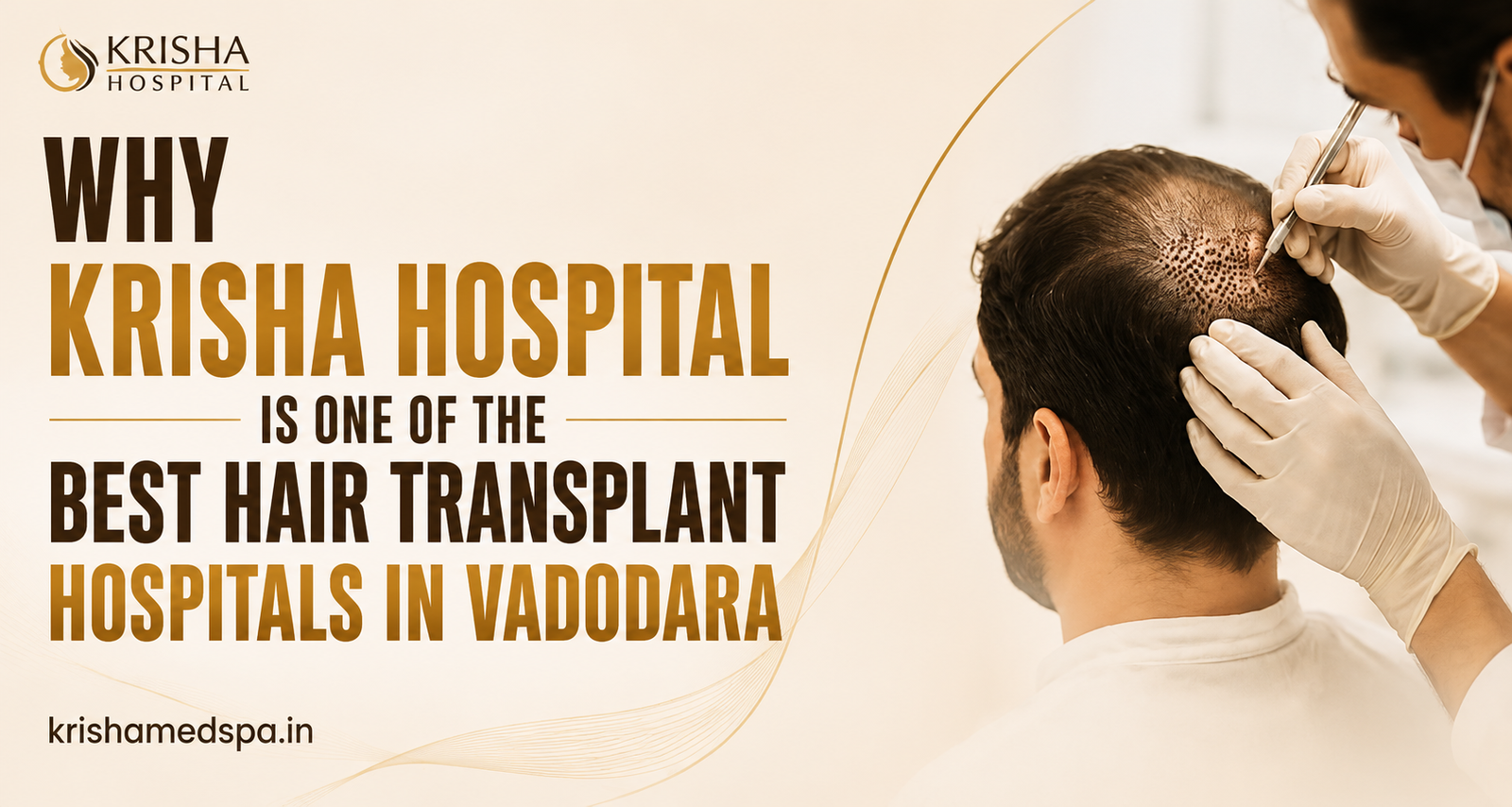
Hair loss can develop gradually or become noticeable within a short period. Genetics, hormonal changes, age, medical conditions, and other factors may affect hair density. Choosing the right treatment therefore requires more than comparing prices.
A reputable hair transplant hospital Gujarat should begin with a proper assessment. It should also explain the difference between surgical transplantation and non-surgical hair restoration. Most importantly, the recommended treatment should match the patient’s hair loss pattern, donor supply, scalp condition, and expectations.
At Krisha Hospital, we provide several hair restoration options in Vadodara, including GFC, FUE, FUT, PRP, and beard hair transplantation. This broad range allows treatment to be selected according to individual requirements rather than following a single approach for every patient.
What Makes a Hair Transplant Hospital Gujarat a Good Choice?
A good hair restoration centre combines medical expertise, appropriate technology, careful planning, and responsible patient communication.
Before treatment, the doctor should examine the scalp and donor area. The extent and pattern of hair loss should also be considered. This assessment helps determine whether a patient needs follicular transplantation or may benefit from a non-surgical option.
A professional consultation should clearly cover:
- The cause and pattern of hair loss
- Donor hair availability
- Recommended treatment technique
- Expected number of grafts or sessions
- Recovery requirements
- Potential risks and limitations
- Estimated treatment costs
- Long-term hair restoration planning
Consequently, patients can make an informed decision instead of choosing a procedure based only on advertising claims.
Hair Restoration Treatments Available at Our Hospital
One major advantage of choosing a hair transplant hospital Gujarat is having access to different treatment approaches. Hair loss varies considerably between patients, so treatment selection should be personalised.
1. GFC Hair Treatment
Growth Factor Concentrate, commonly called GFC, is a non-surgical treatment intended to support hair growth in suitable patients.
The process begins by collecting a small blood sample. It is processed using specialised equipment to obtain a concentrated preparation containing growth factors. This preparation is then injected into areas affected by thinning.
GFC may be considered for men and women with early to moderate hair thinning, particularly when viable follicles are still present.
A typical session takes around 30 to 45 minutes. For a reliable GFC hair transplant procedure, it generally costs between ₹10,000 and ₹25,000 per session, with many patients undergoing three to four sessions at intervals of approximately four to six weeks.
However, treatment frequency and cost can vary. A consultation is necessary to establish an individual plan.
2. FUE Hair Transplant
Follicular Unit Extraction, or FUE, is a surgical hair transplantation technique. Individual follicular units are extracted from a suitable donor area and implanted into areas affected by baldness or thinning.
The procedure generally involves:
- Scalp and donor-area assessment
- Local anaesthesia
- Individual follicle extraction
- Graft preparation
- Recipient-area implantation
- Post-procedure cleaning and instructions
FUE does not require removal of a strip of scalp. It can therefore provide a minimally invasive transplantation option with relatively limited donor-area scarring.
The final appearance depends on several factors. Hairline design, graft quality, extraction technique, placement angle, density, and the patient’s existing hair all influence the outcome.
3. FUT Hair Transplant
Follicular Unit Transplantation, or FUT, uses a different harvesting method.
In FUT, a strip of tissue is removed from a suitable donor region, generally at the back or sides of the scalp. The tissue is then dissected into individual follicular units under magnification. These grafts are subsequently placed into carefully planned recipient sites.
Each follicular unit can naturally contain one, two, three, or four hairs. Proper positioning helps reproduce the direction and pattern of natural hair growth.
FUT can be useful when a substantial number of grafts are required, and the patient has appropriate donor characteristics. Unlike FUE, however, FUT leaves a linear scar in the donor area and involves surgical wound healing.
Therefore, the choice between FUE and FUT should be made after assessing the patient rather than assuming one technique is universally superior.
4. PRP Hair Treatment
Platelet-Rich Plasma, or PRP, is another non-surgical approach for selected types of hair thinning.
A small amount of the patient’s blood is collected and processed in a centrifuge. The platelet-rich component is separated and then injected into targeted scalp areas.
PRP contains growth factors that may support follicular activity and scalp health. It is commonly considered for people experiencing early-stage hair loss or thinning where active follicles remain.
A PRP session generally takes around 45 to 60 minutes. The recent treatment cost estimates ₹4,000 to ₹15,000 per session, with approximately three to six sessions depending on individual requirements.
Mild redness, tenderness, or swelling can occur after injections and usually settles within a short period.
5. Beard Hair Transplantation
Hair restoration can also address sparse facial hair.
Beard transplantation is generally performed using FUE principles. Individual follicles are harvested from an appropriate donor area, commonly the back or sides of the scalp, and transplanted into areas with inadequate beard or moustache growth.
It may be considered for men with:
- Patchy beard growth
- Minimal facial hair
- Sparse moustache or goatee areas
- Hair loss caused by scars or injuries
- Uneven facial-hair density
The transplanted follicles can grow as facial hair after successful establishment. They can subsequently be trimmed or shaved according to personal preference.
GFC, PRP, FUE or FUT: Which Treatment Is Right?
There is no single treatment that is best for everyone.
GFC and PRP are non-surgical options that focus on supporting existing follicles. They may be more relevant when thinning is present but viable hair follicles remain.
FUE and FUT are transplantation procedures. They move donor follicles into areas where greater coverage is required.
Beard transplantation uses follicular transplantation principles for facial-hair restoration rather than scalp coverage.
The distinction is important because these procedures solve different problems. A patient with early thinning may not require surgery, while someone with established bald areas may need a graft-based solution.
How We Plan a Hair Transplant
At Krisha Hospital, we start with assessment rather than immediately selecting a procedure. We consider the pattern of hair loss, donor-area characteristics, existing hair, scalp condition, and the patient’s desired appearance.
The treatment plan should also account for future hair loss. This is particularly important because transplanted hair may remain while surrounding native hair continues to thin.
During consultation, patients should ask practical questions about graft requirements, technique, recovery, expected growth, maintenance, and possible complications.
This transparent discussion helps create realistic expectations before treatment begins.
Why Surgeon Expertise Matters
Hair transplantation is both a medical and aesthetic procedure. Technical execution matters, but so does judgment.
Dr. Rajnikant Parmar is a Gold Medalist in M.Ch Plastic Surgery from M.S. University, Vadodara. His background also includes microvascular surgery training and cosmetic surgery exposure with experienced surgeons.
He has extensive surgical experience and more than 2,500 independently performed hair transplant procedures. Patients can verify professional credentials and relevant experience during consultation before proceeding.
For a hair transplant Gujarat search, surgeon qualifications should be considered alongside technology, treatment planning, facility standards, and follow-up care.
What Is Recovery Like?
Recovery depends on the selected procedure.
GFC and PRP generally involve little downtime. Temporary redness, tenderness, or swelling may occur following injections.
FUE involves healing at individual extraction and implantation sites. FUT requires additional healing because a strip of donor tissue is removed.
Hair growth is gradual. Transplanted hair does not produce its final appearance immediately after surgery. Initial shedding can occur, followed by new growth over the following months.
Aftercare instructions should therefore be followed carefully. Patients should also attend recommended follow-up appointments so that healing and progress can be assessed.
What Should You Consider Before Choosing a Clinic?
When comparing a hair transplant hospital Gujarat, do not rely solely on promotional claims.
Consider these factors instead:
Medical credentials
Check the surgeon’s qualifications, relevant experience, and training.
Treatment suitability
Ask why a particular procedure is recommended and whether alternatives have been considered.
Donor assessment
A realistic plan should account for the amount and quality of available donor hair.
Transparent pricing
Understand what the quoted price includes. Costs may depend on the procedure, number of grafts, sessions, technology, and clinical requirements.
Aftercare
Ask what happens after the procedure and how follow-up appointments are managed.
Realistic expectations
Be cautious of claims promising guaranteed results. Hair growth varies between individuals.
Why Choose Us for Hair Restoration in Vadodara?
We offer multiple hair restoration techniques under one clinical setting. This includes GFC, FUE, FUT, PRP, and beard transplantation.
Our approach focuses on matching treatment to the patient’s condition rather than presenting every person with the same solution. Surgical procedures require careful graft planning, while regenerative treatments require assessment of remaining follicular activity.
We also place importance on explaining the procedure, recovery process, expected timeline, and possible limitations before treatment.
For patients comparing hair transplant Gujarat providers, this personalised approach can make the decision clearer and more practical.
Conclusion
Selecting a hair transplant hospital Gujarat is an important medical decision. The right choice involves more than location or advertised pricing. Patients should look for qualified surgical expertise, appropriate treatment selection, careful donor assessment, modern clinical practices, clear communication, and proper follow-up.
At Krisha Hospital, we provide GFC, FUE, FUT, PRP, and beard hair transplantation in Vadodara to address different hair restoration needs. If you are researching hair transplant Gujarat options, start with a professional consultation. Understanding your condition first makes it easier to choose a treatment that fits your goals, donor availability, and long-term expectations.
Frequently Asked Questions
What is the best hair transplant procedure?
There is no universally best technique. FUE and FUT transplant donor follicles, while GFC and PRP are non-surgical treatments intended to support existing hair. The appropriate option depends on individual assessment.
Is FUE better than FUT?
Not necessarily. FUE avoids strip harvesting, while FUT can provide a substantial number of grafts in suitable patients. Donor characteristics, hair loss, scarring considerations, and treatment goals determine the appropriate method.
Is GFC suitable for severe baldness?
GFC is generally more relevant when functioning follicles remain. Extensive baldness may require a transplantation assessment instead. A doctor should determine suitability after examining the scalp.
How many PRP sessions may be required?
Approximately three to six sessions are commonly recommended. The actual number depends on the patient’s hair loss and response to treatment.
Can a beard transplant look natural?
It can produce natural-looking facial hair when grafts are selected and positioned according to the direction, angle, and pattern of existing beard growth. Patient characteristics also influence the final appearance.
How long does a hair transplant take to show results?
Hair restoration is gradual. New growth develops over several months, and the final result takes longer. Patients should follow the timeline provided by their surgeon.